Anacapa’s Landing: The Boat Arrival Is an Engineering and Access Question
East Anacapa’s cliff setting makes its landing different from an ordinary beach arrival. NPS describes a boat-to-dock ladder and 157 stairs to the island top. Read that physical sequence before choosing the outing, then use the landing’s lighthouse-service history to understand why the access structures were built this way.
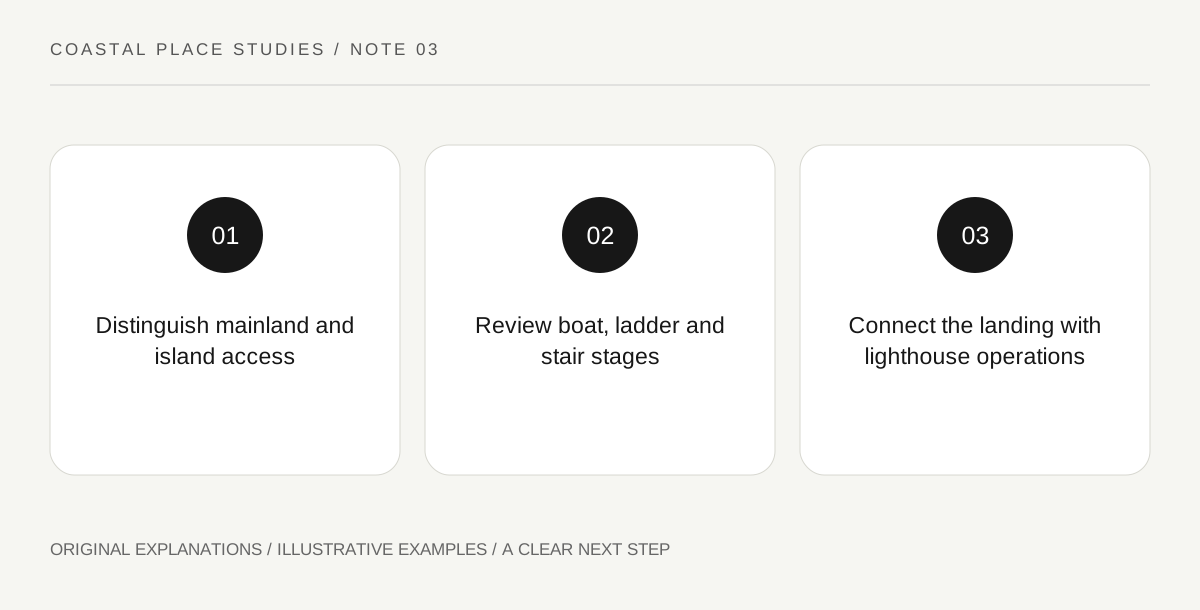
Original explanatory diagram. Read the full method and limitations below.
Separate the mainland visit from the island visit
Channel Islands National Park’s mainland visitor centre in Ventura is reached differently from the islands. NPS explains that island access involves appropriate boats or aircraft, while mainland interpretation can be visited without that crossing. Anacapa is therefore a specific island excursion, not an extension of driving to the mainland address. Confirm the named island and landing in any operator description. A photograph of another island’s beach does not describe Anacapa’s cliff arrival. The mainland centre can also support a distinct learning visit; it should not be mislabelled as evidence that someone has landed on the island.
Read the landing sequence literally
NPS states that visitors climb from a boat up a steel-rung ladder to the dock, then ascend 157 stairs. These are meaningful stages for evaluating the outing. A boat ticket does not remove the need to understand the transfer and climb. Ask the responsible operator and park about the actual arrangements for the individual travellers, including any equipment or mobility questions. This article does not certify suitability from a written description. The return has the same physical setting under potentially different conditions, so do not assess only the outward arrival or assume an alternative road route exists.
Connect the structures with lighthouse work
The NPS landing history describes a multi-level dock, stairs and hoisting equipment developed for lighthouse operations. This gives the dramatic approach a practical historical explanation. The structure solved a problem of moving people and supplies between water and a steep island. A useful diagram separates the landing tiers from the stair connection to the top. Read current interpretation for the surviving, removed or replaced components rather than assuming every piece is unchanged from the original installation. The historic system and its later operational adaptations can be studied together without treating a modern visitor transfer as a reenactment of lighthouse-service work.
Choose a complete island learning objective
Once the physical outing is suitable and confirmed, select a question that fits the available public visit. NPS describes Anacapa interpretation that includes the lighthouse’s original Fresnel lens, but facility opening should be checked for the date. A lens display and the cliff landing address different parts of the same maritime system: projecting a navigational signal and supporting the people and equipment needed to operate it. Keep boat service, landing conditions and indoor access as separate dependencies. The visit can then be described accurately through the parts actually experienced, without inventing a smooth beach arrival or guaranteed building entry.
Illustrative access-chain review
A fictional traveller highlights boat, ladder, dock, stairs and island interpretation as five separate stages. Questions about the transfer go to the operator before a booking decision. A notebook sketch later connects the landing with lighthouse supply work, leaving uncertain equipment details blank. The example is not an operator review, a statement of personal suitability or a promise that conditions will permit a landing on a chosen date.
Practical checks
Optional checkboxes save only in this browser.
Questions that come up
Is Anacapa reached by stepping straight onto a beach?
NPS describes a steel-rung boat-to-dock ladder and stairs to the top of the cliff island. Read the actual landing requirements.
Is the Ventura visitor centre the same as visiting Anacapa?
No. The mainland centre and the island involve different locations and access. Both can provide learning, but they should be described accurately.
References and scope
These sources support the factual background. Examples and exercises are original illustrative teaching material. References do not imply endorsement.
- NPS: Anacapa landing — Boat-to-dock steel-rung ladder, 157 stairs and the history of lighthouse-service landing engineering.
- NPS: Channel Islands basic information — Ventura mainland visitor centre versus island transport, and Anacapa interpretation including its original Fresnel lens.