Point Lobos’ Whalers Cabin: A Building Name Is Not the Whole Occupant History
The building known as Whalers Cabin at Point Lobos has a more complicated history than its name suggests. California’s Office of Historic Preservation describes archaeological evidence associated with Chinese residents and unresolved questions about occupation. Read the cabin as a case study in how objects, buildings and inherited labels can tell different parts of a coastal story.
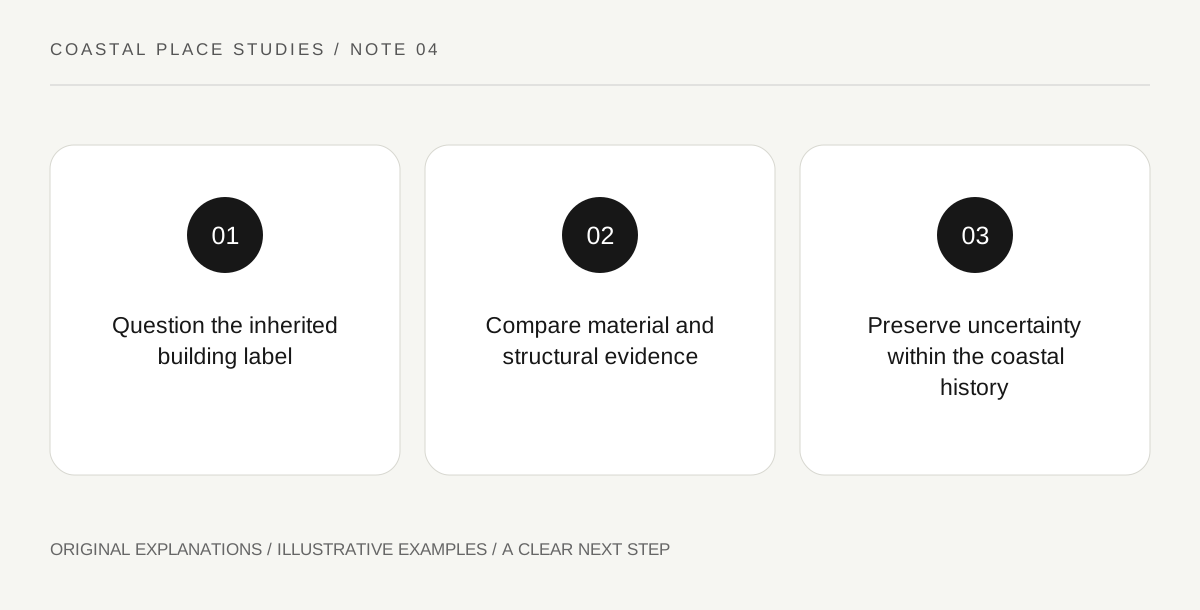
Original explanatory diagram. Read the full method and limitations below.
Start with the official uncertainty
The state’s historic-resource description reports that archaeological work challenged a long-accepted whaling association and prompted investigation of former occupants. That is a useful starting point: the name of a historic building can preserve one interpretation without settling every historical question. Do not replace the old simple story with a new equally absolute claim. Read the source’s language about evidence and remaining research. A visitor can understand why an interpretation changed while acknowledging that the surviving record may support several phases or overlapping associations rather than a single uninterrupted identity.
Connect finds with the occupation question
The official account describes material found during work beneath the cabin in 1986, including pottery fragments, chopsticks and other objects consistent with Chinese residency. The significance lies in the relationship between finds, their context and other evidence. A single object does not necessarily identify every person who lived in a building. Ask how several kinds of material support an interpretation together. If an exhibition displays an object, distinguish that labelled specimen from an illustrative photograph of a similar item. The method is archaeological reasoning, not guessing an occupant’s identity from the building’s exterior or from one decorative detail.
Read the structure through later work
The preservation account also describes the cabin’s physical construction and later foundation work. A historic building can retain important evidence while incorporating conservation interventions. Do not assume every material visible today belongs to its earliest phase, and do not inspect by lifting, scraping or entering restricted areas. Use the available interpretation to identify which parts are being discussed. The relationship between a structure and its sub-floor finds can be explained through a diagram or written account even when the evidence is not exposed. Preservation often protects the very context a visitor might otherwise want to see directly.
Place the cabin within the reserve’s changing coast
California State Parks describes Point Lobos as a place with ecological value and a history of industrial activities, including whaling and abalone processing. The cabin therefore belongs to a wider coastal landscape of work and later protection. A focused visit can compare that historical question with the reserve’s present conservation purpose without assuming all industrial evidence remains visible. Check current access and any cabin exhibition opening separately from general reserve entry. Leave with a sourced account of what is known, what was revised and what remains uncertain. That is a stronger result than treating the building’s familiar name as a complete biography.
Illustrative evidence table
A fictional notebook has columns for the building’s traditional name, archaeological finds, other records and unresolved questions. The state resource entry supplies the evidence; the visitor does not invent an occupant from a single shard. A final line distinguishes current building access from the history being studied. The example demonstrates historical reasoning rather than reporting an excavation, a personal visit or guaranteed museum entry.
Practical checks
Optional checkboxes save only in this browser.
Questions that come up
Does the name prove only whalers lived there?
No. The official preservation account describes evidence associated with Chinese residency and further questions about the cabin’s occupation history.
Can one object establish the full history of a household?
Not by itself. Archaeological interpretation depends on context and multiple evidence sources. Avoid expanding a single find into a complete personal story.
References and scope
These sources support the factual background. Examples and exercises are original illustrative teaching material. References do not imply endorsement.
- California State Parks: Point Lobos — The reserve’s ecology and former coastal industries, alongside current park visitor information.
- California Office of Historic Preservation: Whalers Cabin — Archaeological finds beneath Whalers Cabin, evidence of Chinese residency and unresolved occupation questions.