Point Reyes Lighthouse: Parking, Visitor Centre and Tower Are Three Stages
The Point Reyes Lighthouse visit involves a headland approach, a walk to the visitor centre and a further stair descent to the historic tower. NPS describes each stage separately. Understanding that sequence prevents a lighthouse photograph or an open parking area from becoming an assumption that every part of the visit is available.
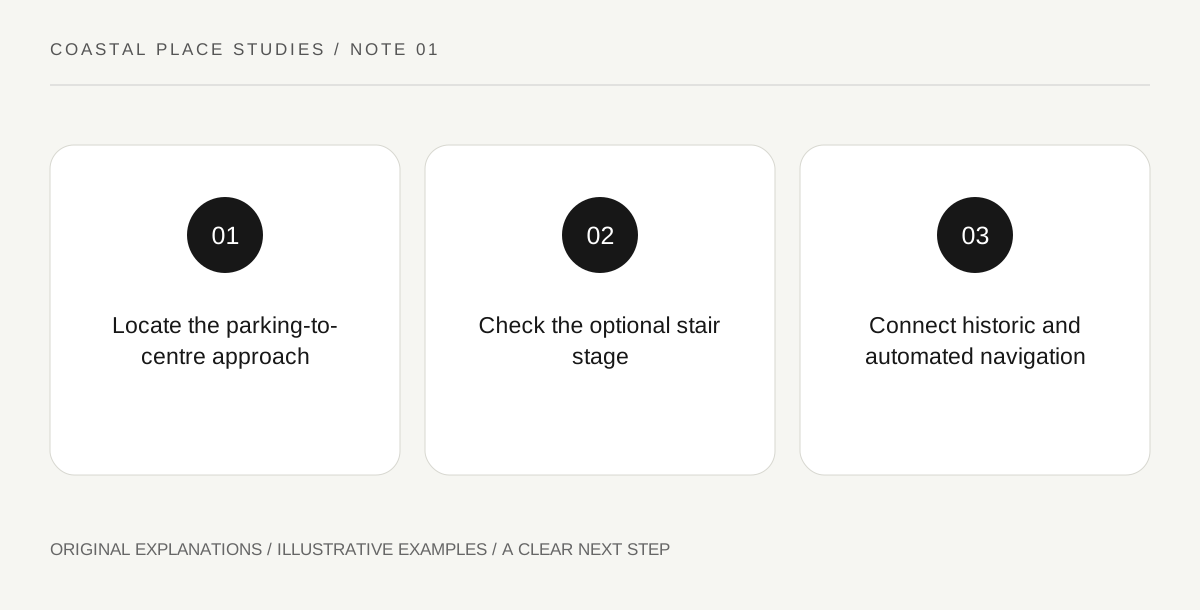
Original explanatory diagram. Read the full method and limitations below.
Locate the end of the drive
NPS places the lighthouse at the western end of the Point Reyes Headlands and describes a slow, winding approach from the wider park area. The visitors’ parking lot is not beside the tower entrance. Use the current lighthouse map to identify the parking area, the pedestrian approach and the location of visitor facilities. An estimated arrival at the parking lot therefore starts another part of the visit rather than completing the journey. Keep any specific access needs attached to the actual stages. A vehicle route and a pedestrian route can have different restrictions even within one named lighthouse area.
Separate the walk from the stair descent
The official description identifies an uphill approach to the Lighthouse Visitor Center followed by 313 steps down toward the lighthouse itself. The return includes climbing those steps again. Do not describe the visit only as a descent or use the tower’s distance from parking to conceal its vertical component. Someone may choose the visitor-centre and observation experience without including the lower stair route. Check the current accessibility information for the exact facilities required. The useful question is which stage offers the desired historical learning and view, not whether every visitor completes an identical route.
Treat opening and wind as different conditions
NPS directs visitors to current opening information and explains that strong winds can close the lighthouse stairs. An advertised opening day does not cancel that weather dependency. Read the actual notice and follow gates and staff instructions. Do not step beyond rails or use a closed section to reproduce a photograph from another date. Fog and other coastal weather can also alter the view without changing the historical significance of the site. A plan based on the visitor centre and available interpretation remains more coherent than one that defines success solely as standing beside the tower.
Read the historic and automated lights separately
NPS dates the historic lighthouse to 1870 and explains that it retired from service in 1975 when the Coast Guard installed an automated light nearby. That distinction gives the visit a concrete maritime question: how does a preserved historic structure relate to continuing navigation? Read the interpretation for the tower and its equipment rather than assuming every visible light is the same installation. An available view may show different parts of this relationship. Keep the date and source attached to your historical notes, then record which visitor areas were actually open during your own visit instead of blending access and history into one timeless account.
Illustrative stage choice
A fictional group draws three boxes for parking, the visitor centre and the tower stairs. One person’s needs make the final stage unsuitable, so the group checks the current visitor-centre arrangements and chooses a maritime-history question that can be explored there. The example does not certify an accessible route, predict wind or guarantee tower entry. It demonstrates why the stages should be evaluated separately.
Practical checks
Optional checkboxes save only in this browser.
Questions that come up
Does reaching the parking lot mean reaching the lighthouse?
No. NPS describes a walk to the visitor centre and a further stair descent toward the tower. Evaluate those stages separately.
Can the stairs close on a normal opening day?
Yes. NPS identifies a wind-related closure condition. Follow the current status and barriers rather than relying only on the regular calendar.
References and scope
These sources support the factual background. Examples and exercises are original illustrative teaching material. References do not imply endorsement.
- NPS: Point Reyes Lighthouse — Parking, visitor-centre approach, 313 stairs and wind-related closure; current facility status must be checked.
- NPS: Point Reyes lighthouse history — Historic lighthouse construction and navigation purpose, followed by replacement with an automated light in 1975.