Fire Island: Choose the Lighthouse, Wilderness Edge or Sunken Forest Before Transport
Fire Island National Seashore is reached through several different destinations and transport approaches. NPS distinguishes the lighthouse area, the wilderness visitor centre and mid-island sites such as Sailors Haven. Pick the intended place first; a ferry to one community does not automatically deliver a visitor to every national-seashore attraction.
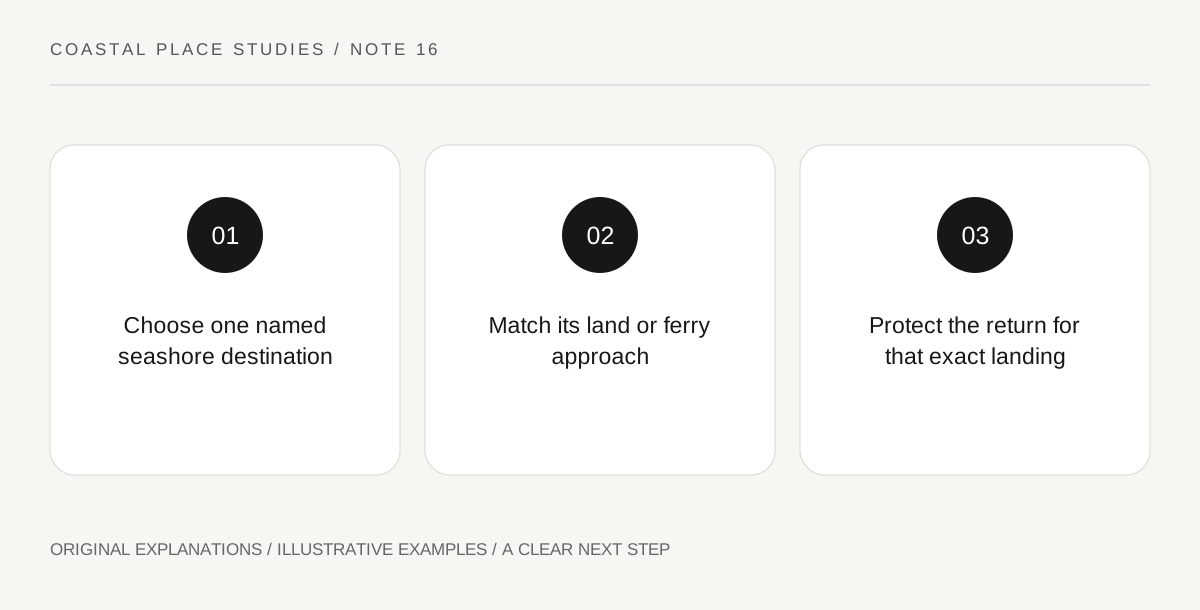
Original explanatory diagram. Read the full method and limitations below.
Unpack the seashore name
The NPS directions page lists multiple Fire Island destinations and several ways to approach them. A national-seashore boundary is therefore not one arrival point. Begin by writing the exact site and its nearest appropriate transport connection. A booking described only as Fire Island can leave the meeting place unclear. Keep the mainland terminal, island landing and final public route as separate fields. This is particularly important when comparing a car-accessible approach with a passenger-ferry outing: the modes serve different parts of the place and should not be treated as interchangeable without checking the actual destination.
Distinguish the lighthouse and wilderness approaches
NPS identifies land approaches for the Fire Island Lighthouse and Wilderness Visitor Center, while many mid-island locations rely on passenger ferries or other appropriate arrangements. These are geographical distinctions rather than a guarantee that every building is open year-round. Check the intended site’s current visitor information after identifying the approach. A drive to one end of the island does not establish a through-drive to a mid-island attraction. Avoid using a broad island map to invent a road connection or assuming that a visible line along the barrier island is a suitable visitor route across its whole length.
Give Sailors Haven a specific ecological question
NPS identifies the Sunken Forest at Sailors Haven as a rare maritime holly-forest community behind established dunes. That gives the mid-island visit a subject beyond simply reaching another beach. A useful question concerns how a forest can persist in the shelter of a barrier-island setting. Use the current interpretation and permitted boardwalk arrangements rather than leaving the route to inspect the understory. The forest is also a changing research landscape, not a frozen scene guaranteed to match an old photograph. A plant identification or ecological claim should come from the relevant guide rather than a visitor’s quick guess.
Read return transport for the chosen landing
Once the destination is clear, use the current operator’s timetable and conditions for the actual route. Ferry availability is seasonal and destination-specific, and a general NPS description does not reserve a seat or promise the final departure. A different landing may involve a different mainland terminal and an additional travel problem. Keep the return linked to the booked or confirmed route rather than assuming any boat will take you back to the right place. A complete visit can focus on one site, with enough time to understand its subject, instead of attempting to join the whole island into an improvised day-long crossing.
Illustrative destination decision
A fictional visitor compares a lighthouse-history day with a Sunken Forest learning day. The first uses the relevant land approach; the second requires its own confirmed mid-island transport and permitted visitor route. The visitor selects one and records its specific return. The example gives no ferry timetable, through-island route or guarantee that a visitor centre, forest boardwalk or lighthouse interior is open.
Practical checks
Optional checkboxes save only in this browser.
Questions that come up
Does any Fire Island ferry serve every attraction?
No. NPS describes different destination approaches. Match the actual landing and onward route to the site you intend to visit.
Does a land approach mean a building is always open?
No. Being able to reach a site geographically and finding its facilities open are different questions. Check the current venue information for the date.
References and scope
These sources support the factual background. Examples and exercises are original illustrative teaching material. References do not imply endorsement.
- NPS: Fire Island directions — Distinct approaches for the lighthouse, wilderness visitor centre and mid-island ferry destinations.
- NPS: Fire Island Sunken Forest — Maritime holly forest behind dunes and its ecological importance; not proof of current boardwalk opening.