Jamaica Bay Wildlife Refuge: Two Ponds, Different Visitor Questions
Jamaica Bay Wildlife Refuge places wetlands and bird habitat within New York City’s wider coastal landscape. NPS distinguishes the West Pond route from the East Pond environment and identifies sensitive areas. Choose a habitat-study question and an authorised observation place rather than assuming both ponds offer identical routes or unrestricted shoreline access.
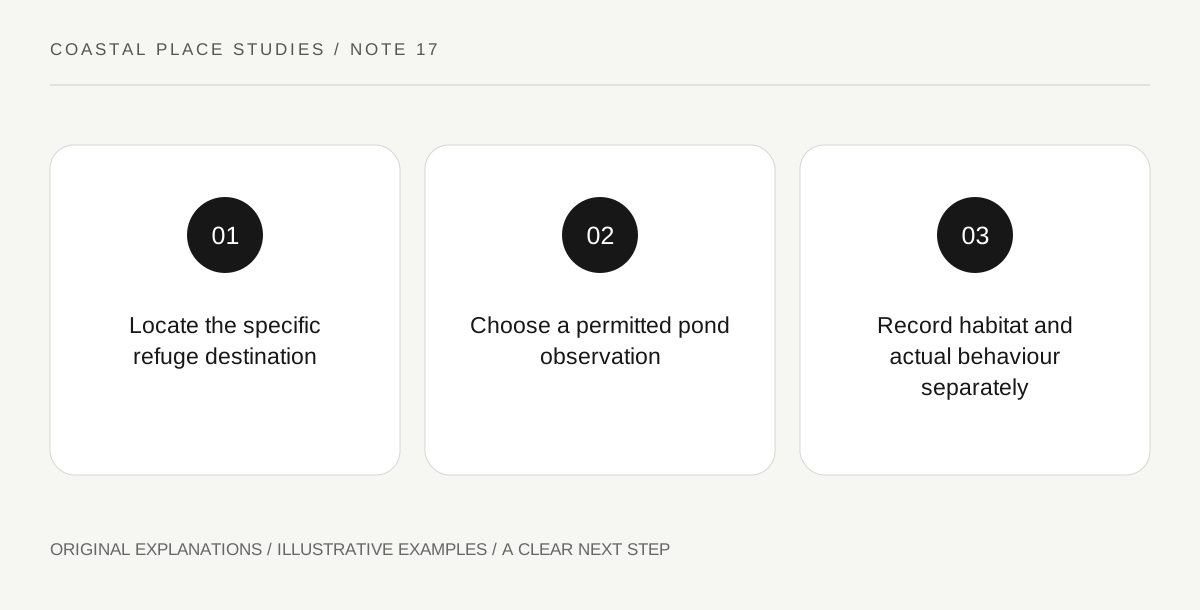
Original explanatory diagram. Read the full method and limitations below.
Locate the refuge within Gateway
Jamaica Bay Wildlife Refuge is one place within the larger Gateway National Recreation Area. That context matters because another Gateway destination’s beach facilities or transport instructions do not describe this site. Start with the refuge visitor location and current map. The learning opportunity concerns coastal habitat, migration and the relationship between water and land in an urban region. A distant city skyline can be part of the view without making the wetlands an ordinary city park lawn. The refuge’s conservation purpose should guide the kind of observation planned and the specific public area selected.
Read the West Pond route as a habitat sequence
NPS describes a wide gravel route associated with West Pond and identifies saltmarsh, mudflats, shore and woodland environments. These habitats support different questions. From a permitted position, compare open water with a vegetated edge or a wooded area rather than treating the entire view as one uniform wetland. A notebook can record water, vegetation and observed bird behaviour in separate fields. Use the park’s interpretation for species and habitat names. If identification is uncertain, describe what the bird was doing without assigning a confident name from a small distant silhouette.
Do not transfer one pond’s access assumptions to the other
The NPS description places East Pond across from the visitor-centre side and notes that its visit requires preparation. The stewardship material also identifies sensitive pond and saltmarsh areas where public access is restricted. Therefore a route description for West Pond should not be copied into an East Pond plan. Read the current area-specific instructions and follow boundaries. This article does not provide a mudflat approach or a route into sensitive habitat. A public observation point can answer a focused ecological question without approaching every waterline or treating a bird’s position as an invitation to follow.
Make migration evidence specific
The refuge is known for birds using it during migration, but the official significance does not guarantee a particular species or number during a short visit. Record date, location, observation duration and actual behaviour. Distinguish a personal sighting from a species listed in a guide. A blank observation can reflect timing, distance or limited visibility rather than an absence from the entire refuge. Choose current authorised nature-study or interpretation opportunities if available, checking their own programme. The result is a useful urban-coast visit when it explains habitat relationships honestly, even without an exceptional bird encounter or access to both ponds.
Illustrative habitat comparison
A fictional observer stays on a permitted West Pond route and compares an open-water view with a wooded edge. The notes record observed feeding or resting behaviour only where visible, while a separate column lists questions for the park guide. East Pond remains unvisited until current instructions are checked. This is a suggested method, not a sighting report, birding-route certification or permission to enter sensitive shore areas.
Practical checks
Optional checkboxes save only in this browser.
Questions that come up
Can I use West Pond directions for East Pond?
No. NPS describes different visitor environments, and sensitive areas have specific restrictions. Read the current instructions for the intended pond.
Does a migration hotspot guarantee a rare bird?
No. The designation explains ecological importance. Actual observations depend on date, conditions and the limited period and place being watched.
References and scope
These sources support the factual background. Examples and exercises are original illustrative teaching material. References do not imply endorsement.
- NPS: Jamaica Bay Wildlife Refuge — West Pond and East Pond are different visitor environments within a coastal habitat and migration setting.
- NPS: Jamaica Bay stewardship — Nature study and passive recreation alongside sensitive pond and saltmarsh areas with restricted public access.