Fort Ross: Distinguish Original Fabric, Reconstruction and a Wider Community
Fort Ross presents a coastal historic landscape through surviving material, reconstructed buildings and interpretation of several communities. California State Parks distinguishes the Rotchev House from reconstructed compound structures. Reading those categories carefully also creates room for the Kashia Pomo, Alaska Native and later ranch histories that a Russian-colony-only description can overlook.
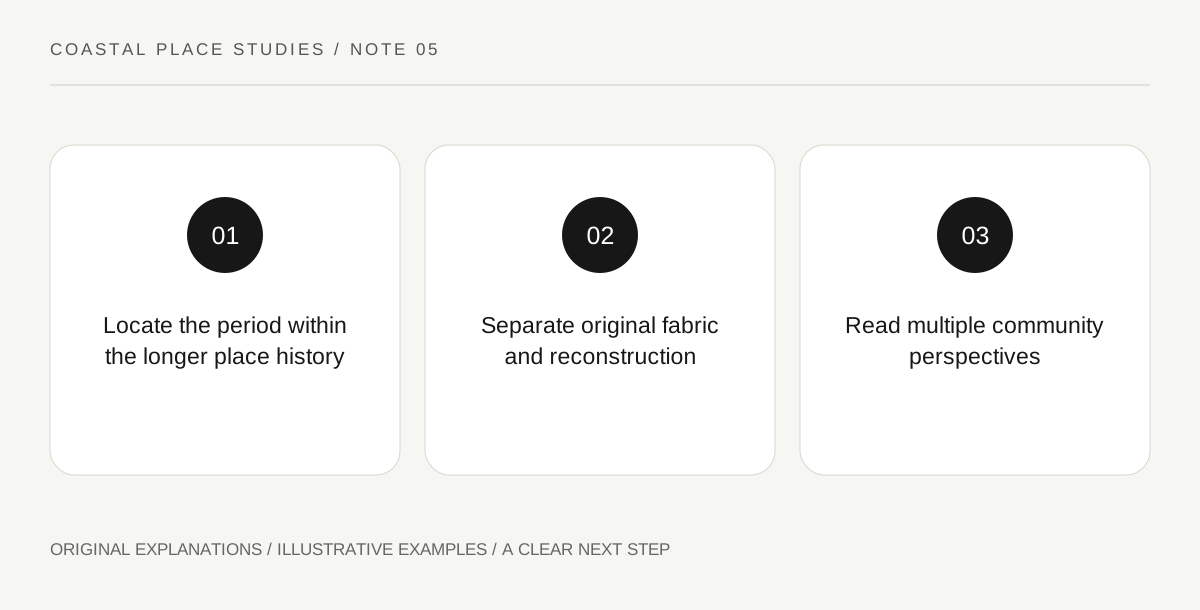
Original explanatory diagram. Read the full method and limitations below.
Begin with the broader place history
The park’s current overview places the Russian colonial period within a longer account that includes resident Kashia Pomo people, later ranching and the protected park era. This chronology prevents the compound from becoming the entire history of the coast. Identify the period addressed by each display before combining its claims with another. A photograph of a reconstructed building can illustrate one part of that story, but it cannot represent every community or century equally. The cultural landscape extends beyond the most visually recognisable structures, so a visit should keep the wider place in view from the start.
Separate the Rotchev House from reconstructed structures
California State Parks’ structural history identifies the Rotchev House as surviving Russian-period fabric and describes other visible compound buildings as reconstructions. That distinction affects what the visitor is looking at. A reconstruction can explain a lost arrangement, while original fabric may preserve direct evidence of past construction. Neither category should be hidden. Read the particular building’s interpretation rather than assigning one age to the whole compound. Avoid describing all timber as untouched nineteenth-century material or, in the opposite direction, dismissing the entire site as a replica. The useful question concerns which evidence supports each visible form.
Read changes and losses as part of preservation
The state account documents repairs, earthquake damage, fire and later reconstruction campaigns. The present setting is therefore the outcome of historical change and conservation decisions. Ask what was retained, what was rebuilt and how the interpretation explains uncertainty. A building’s restored appearance may intentionally represent one period while its physical history contains many others. This is a good reason to keep date and purpose separate in a notebook. Do not date a repair from appearance alone, and do not treat access to a courtyard as permission to enter every building or examine structural details by touch.
Look for interpretation that includes community voices
State Parks has announced work to broaden Metini–Fort Ross interpretation through partnership and consultation with the Kashia Band of Pomo Indians. That process recognises the limits of an older narrative concentrated on the Russian settlement. Read the actual current exhibits and community contributions without claiming that a proposed interpretive project has already changed every display. A useful visit asks whose work, residence and relationships are represented and whose perspective needs further learning. Check the current programme for any guided or community-led activity. The aim is a more accurate account of a shared coastal place, not a catalogue of national labels attached to buildings.
Illustrative building-and-story matrix
A hypothetical visitor makes rows for the Rotchev House, one reconstructed structure and a landscape interpretation panel. Columns distinguish surviving material, represented period and people discussed. An empty cell remains a question for the official explanation. The exercise does not claim every structure is open or every new interpretive proposal has been completed. It demonstrates how material status and historical perspective can be recorded together.
Practical checks
Optional checkboxes save only in this browser.
Questions that come up
Are all compound buildings original?
No. State Parks distinguishes the surviving Rotchev House from reconstructed structures. Read the interpretation for the particular building.
Is Russian settlement the whole history of Fort Ross?
No. The park overview includes Kashia Pomo history, multiple resident communities, later ranching and preservation. The compound represents only part of that longer landscape history.
References and scope
These sources support the factual background. Examples and exercises are original illustrative teaching material. References do not imply endorsement.
- California State Parks: Fort Ross — Kashia Pomo, Russian colonial, ranching and park histories; multiple communities in the coastal landscape.
- California State Parks: Fort Ross reconstruction — The surviving Rotchev House, reconstructed compound structures and their conservation history.
- California State Parks: Metini-Fort Ross interpretation 2026 — State Parks’ announced co-created interpretation and Kashia Tribal consultation broaden a Russian-colony-only narrative.