Fort Stevens: A Shipwreck and a River-Defence Site Tell Different Stories
Fort Stevens State Park combines coastal recreation with military remains and the Peter Iredale shipwreck. Oregon State Parks maps these as different features within a large park. Choose the historical question first so a beach photograph does not become an assumption that the wreck, batteries and museum are all one compact attraction.
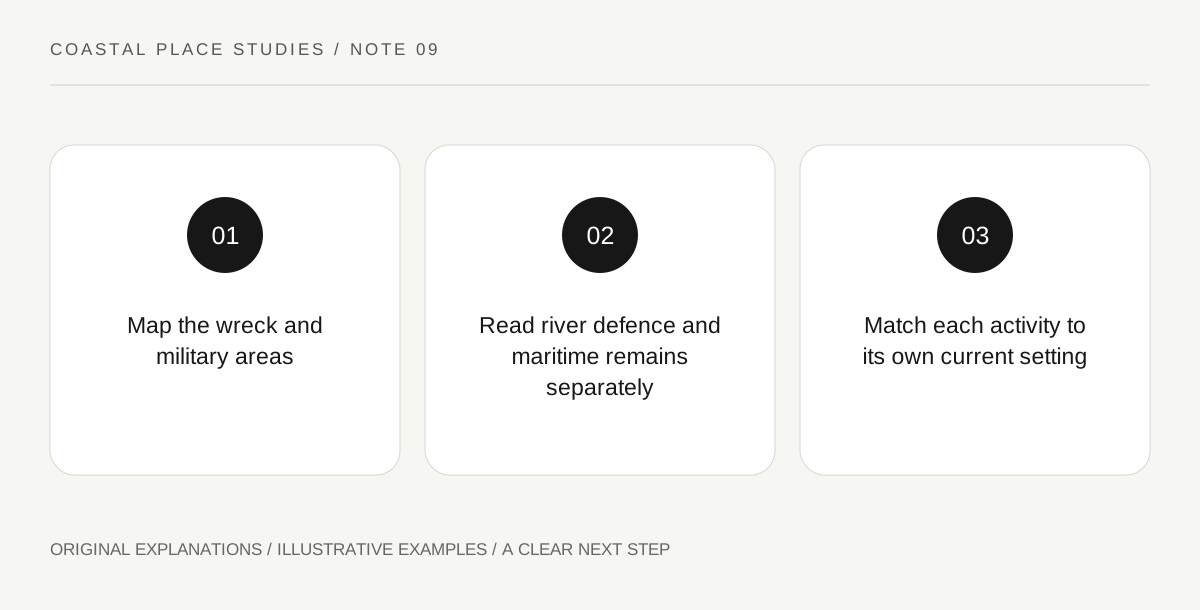
Original explanatory diagram. Read the full method and limitations below.
Locate the two historical subjects
The state park overview identifies Fort Stevens with defence of the Columbia River entrance and also lists the shipwreck as a visitor feature. These are connected by a coastal setting, but they do not tell the same story. Put the historic military area and the wreck access on the current park map before choosing an arrival point. A campground address or a generic park pin is not a complete direction to either subject. The official map helps show why moving between them consumes real time. A visitor can deliberately choose one without claiming to have covered the whole park.
Read river defence through position and purpose
Oregon State Parks explains that the military installation guarded the mouth of the Columbia from the Civil War through the Second World War. Start with the waterway being protected, then use the military-site interpretation to understand the particular battery or structure. The fort changed over time, so one surviving concrete work should not be assigned to every period of its operation. A map-based question about position and range can guide observation without entering a closed interior. Check the current status of any museum, demonstration or building you intend to include; the site’s historical significance does not guarantee a staffed programme.
Treat the wreck as exposed historic material
The park map identifies the Peter Iredale remains near a beach access. What is visible can vary with the shore and conditions. Do not promise a particular amount of exposed hull or treat an old image as a current condition report. Observe the remains from permitted areas without climbing, altering or removing material. The shipwreck can introduce a question about maritime movement and the difficulty of a coastal approach, but detailed claims about the vessel’s final voyage need their own historical interpretation. The visible iron alone cannot supply every event in that story.
Keep the modern park’s functions distinct
Fort Stevens also includes trails, a freshwater lake, camping and other recreation. A mention of swimming at a lake facility does not establish suitable ocean conditions beside the wreck. Likewise, a campsite reservation does not reserve a museum activity or authorise every vehicle movement on the beach. Check the actual area and current rules for the chosen activity. A well-bounded visit might pair one military interpretation stop with a separate permitted wreck view, while keeping the broader park optional. The point is to understand two coastal histories through their correct settings rather than turn a large recreation area into an unrealistic checklist.
Illustrative two-subject plan
A fictional pair marks “river defence” and “shipwreck remains” as separate map destinations. They check current military-area access first and keep the wreck view dependent on the actual shore conditions. Their notebook uses different headings for the two histories and makes no claim about hull exposure. This example supplies no beach-driving route, tide prediction, programme availability or guaranteed admission to a building.
Practical checks
Optional checkboxes save only in this browser.
Questions that come up
Are the shipwreck and military museum one stop?
They are separate features within a large park. Use the current map and access information rather than assuming one parking area serves everything.
Will the wreck look exactly like a photograph?
Not necessarily. Visibility and the surrounding shore can change. Treat a photograph as a dated record rather than a future exposure guarantee.
References and scope
These sources support the factual background. Examples and exercises are original illustrative teaching material. References do not imply endorsement.
- Oregon State Parks: Fort Stevens — Columbia River defence, historic military sites, the shipwreck and distinct recreational features.
- Oregon State Parks: Fort Stevens map — Map distinguishes the military area from Peter Iredale shipwreck access; a 2023 map does not establish current opening.