Fort Worden: Hidden Batteries and Visible Community Buildings
Fort Worden’s coastal-defence history includes concealed artillery works and a visible community of barracks and other buildings. Washington State Parks explains the contrast and the site’s later reuse. A focused visit asks why different structures look so different, while checking present-day access independently of their historical functions.
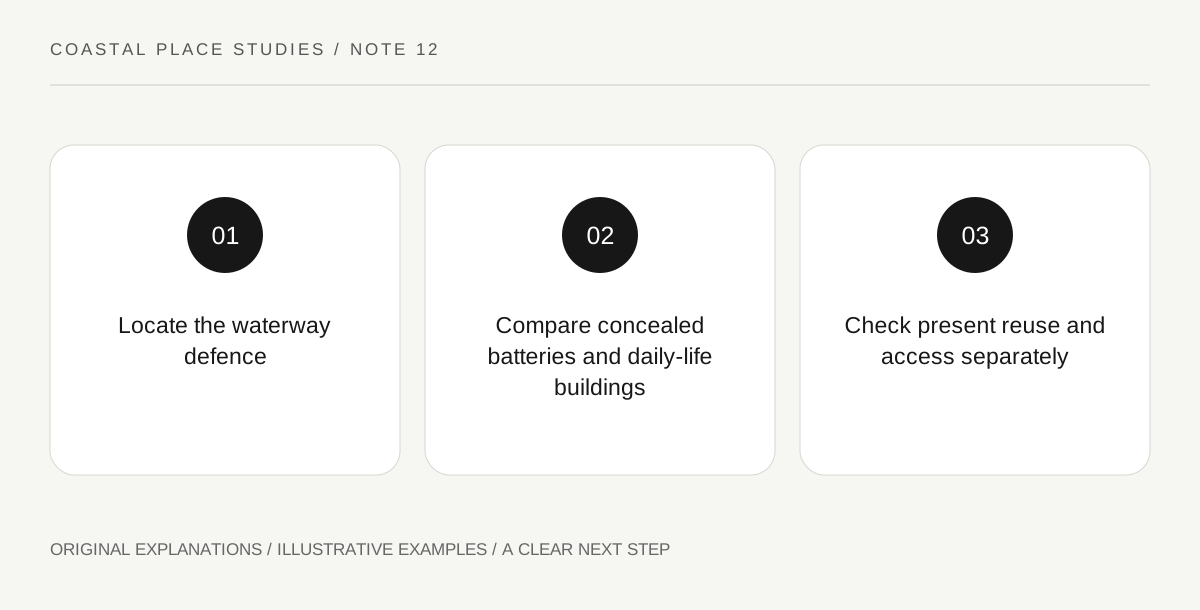
Original explanatory diagram. Read the full method and limitations below.
Locate the defended waterway
Washington State Parks places the fort within the defence of Admiralty Inlet at the entrance to Puget Sound. Start with that geographical relationship rather than treating each concrete structure as an isolated bunker. A map can show why position mattered to the wider system. The fort’s role also changed as military technology developed. Use the state’s historical account to establish the period of a particular feature before drawing conclusions about what it could do. A modern view of ships moving through the inlet can introduce the geography, but it does not recreate the technical conditions of an earlier military era.
Read concealment as a design choice
The official history explains that the Endicott-era approach used concrete works and guns designed to be less conspicuous from the sea than a traditional monumental fortress. This changes how the site should be read: an apparently modest mound or low wall may have belonged to a sophisticated defensive arrangement. Use the interpretation to understand the gun position and supporting spaces. Do not enter a dark or closed area to complete a diagram, climb structures or assume a missing railing establishes an approved viewpoint. Historical design can be explained from authorised public positions without treating every surviving opening as a recreational route.
Compare batteries with buildings for daily life
The same military installation required housing, barracks, administration and other support functions. These visible buildings answer a different question from a concealed gun position. Compare their relationship to circulation, gathering and everyday work through official maps and labels. Avoid assuming every present occupant or activity matches the original building use. A former military building can be adapted, closed or managed by a separate organisation. A visitor’s note should distinguish original purpose, later change and current function where verified. That three-part description explains more than calling every structure simply a fort building.
Keep later reuse and present access distinct
The state history describes post-military uses and the development of the park, including educational and cultural activity. It also records changes in management arrangements, so older accommodation or conference descriptions should not be treated as current booking instructions. Check the responsible venue or park’s latest information for any interior, performance or stay. A heritage walk and a paid cultural programme are separate experiences even when they share the campus. Choose one comparison that is actually available, such as coastal-defence concealment versus the visible community layout. The visit remains useful when it is grounded in confirmed public access rather than an assumed campus-wide invitation.
Illustrative building comparison
A fictional notebook compares a labelled battery with a former barracks building visible from a permitted public area. Columns record original function, design priorities and verified current use. A proposed interior visit remains unconfirmed until its own operator information is checked. The example does not repeat a private visitor’s adventure, prescribe climbing through batteries or guarantee accommodation in a historic building.
Practical checks
Optional checkboxes save only in this browser.
Questions that come up
Why do some defensive works look less like a castle?
The state history explains an approach emphasising concealment and concrete artillery positions. Their form reflects a particular military design problem.
Does park entry include every campus building or event?
No. Interiors, programmes and accommodation can have separate managers and current arrangements. Check the specific activity rather than assuming universal access.
References and scope
These sources support the factual background. Examples and exercises are original illustrative teaching material. References do not imply endorsement.
- Washington State Parks: Fort Worden history — Concealed concrete batteries, community buildings and later reuse. Legacy management arrangements are not used for current booking claims.