Indiana Dunes: National and State Park Passes Have Separate Scope
Indiana Dunes contains both a national park and a state park. NPS explicitly explains their separate ownership, fees and passes. Identify the actual area before choosing an entrance product so a familiar destination name or a federal pass does not become an assumption that every nearby parking or visitor facility is covered.
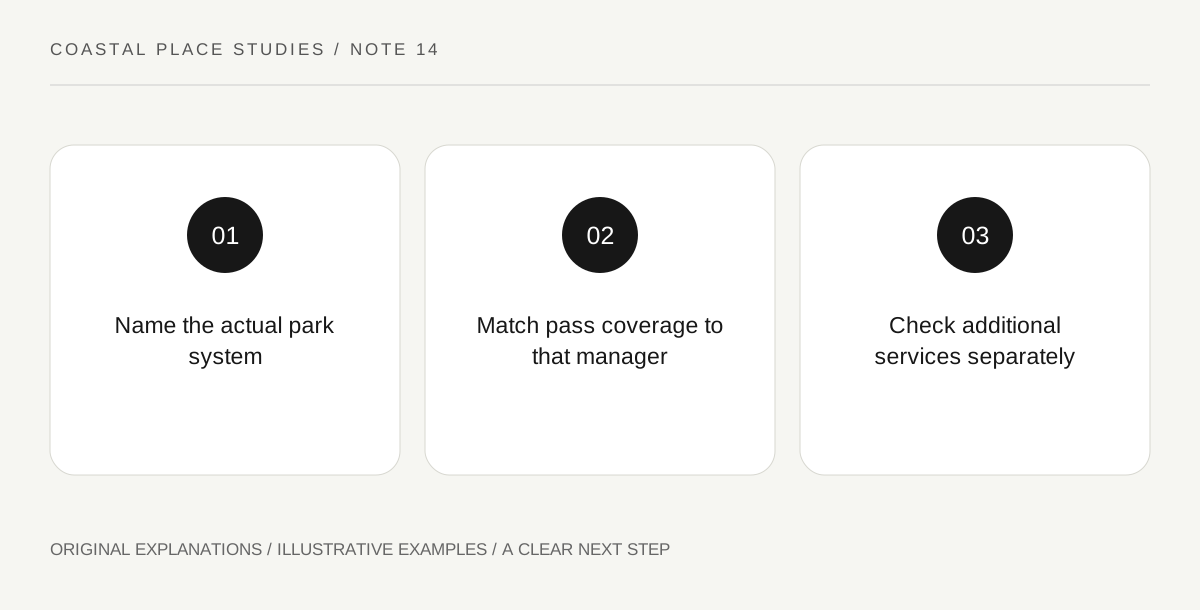
Original explanatory diagram. Read the full method and limitations below.
Write the full park name
The NPS fees page distinguishes Indiana Dunes National Park, owned by the federal government, from Indiana Dunes State Park, owned by Indiana. Both share the regional dunes name, which makes a shortened itinerary label ambiguous. Begin with the exact destination and its responsible manager. A map pin for one park should not be combined with fee information from the other simply because the names look similar. The practical task is to match the location, entrance and source. Keep the full name on a group itinerary or saved map so different travellers do not arrive at separate facilities expecting to meet.
Read a pass as a defined entitlement
NPS states that the parks have separate fees and passes that do not work interchangeably. A pass is therefore an entitlement within a specified system, not a general badge for the entire landscape. Read the current eligibility and coverage of any pass already held. If one park’s admission is covered, record that fact alongside the exact park name. Leave the other area unconfirmed until its own official information is checked. This article does not reproduce fixed prices or assume a particular residency or discount category. Current pass products and conditions should be read for the actual travellers.
Separate entry from additional services
Even after the correct entrance arrangement is identified, other activities may have their own conditions. A campsite, organised programme or another paid service should be checked as a specific product rather than assumed from an entrance pass. Likewise, holding an admission entitlement does not reserve a parking space or guarantee that an area is currently open. Build a small record with location, manager, entry product and any additional booking. The exercise is especially useful when a day includes stops in both park systems, because it makes each cost and access dependency visible without requiring a complicated budget spreadsheet.
Choose the destination for the visit’s purpose
Do not let pass ownership choose the whole experience before identifying what you want to learn or do. Select a particular permitted beach, interpretation opportunity or landscape question through the relevant park’s current information, then apply the admission rules to that choice. A regional dunes visit can remain simple when it centres on one named area. There is no need to add the other park merely to use another pass or complete a map. If plans change, update the manager and access fields as well as the destination. That final step prevents an old fee assumption from surviving a new choice of entrance.
Illustrative two-row admission sheet
A fictional traveller lists one national-park stop and one state-park stop on separate rows. A federal pass is recorded only against the area it actually covers under the current rules. The second row remains subject to the state park’s own information, while a proposed campsite is a third, separate booking question. The example uses no fixed prices and does not imply that a pass reserves parking or confirms a campsite.
Practical checks
Optional checkboxes save only in this browser.
Questions that come up
Does a federal pass cover Indiana Dunes State Park?
NPS says the national and state parks have separate fees and passes that do not work between them. Check the state park’s own current arrangements.
Does an entrance pass reserve a parking place?
Do not infer that. Admission coverage, parking availability and any separately booked service are different conditions that need their relevant current information.
References and scope
These sources support the factual background. Examples and exercises are original illustrative teaching material. References do not imply endorsement.
- NPS: Indiana Dunes fees and passes — National and state parks have separate ownership, fees and passes; checked 20 October 2026 without reproducing fixed prices.